
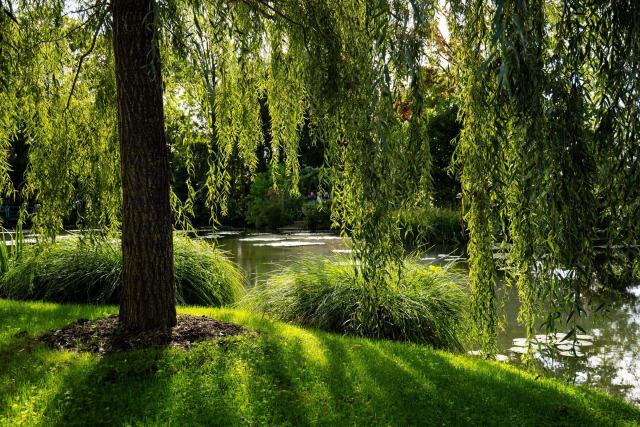
Giverny by car is the most flexible Paris to Giverny day trip: about 75 km of motorway, roughly 1 h 15 min, and you reach Claude Monet's house and garden, the lily pond and the Japanese bridge with no train or transfer at Vernon. Your own vehicle lets you visit at opening time and travel on into Normandy.
- Route: A13 motorway west from Paris, exit 14 towards Vernon and Giverny, then small roads along the Seine.
- Driving time: about 1 h 15 min each way on a quiet day, longer on Sunday evenings heading back.
- Best moment: weekday, at opening time, from April to June for the flowers.
How to get to Giverny by car from Paris
The simplest route from Paris to Giverny follows the A13 motorway, the main road towards Rouen and the Normandy coast. From the west of the city (Porte d'Auteuil or Porte de Saint-Cloud) you join the A13 directly; from the east or the north, the Boulevard Périphérique brings you there. Before leaving, read our advice for getting out of Paris without stress, because the first 15 km usually take longer than the next 60.
After Mantes-la-Jolie, stay on the A13 until exit 14 (Bonnières-sur-Seine), then follow signs for Vernon and Giverny. The last part of the drive runs on a departmental road through fields and small villages beside the Seine, which is one of the pleasures of the day. Your GPS will offer the same route; enter "Fondation Claude Monet, Giverny" rather than the village name so that it guides you close to the car parks.
The A13 is a toll motorway: you pay at the barrier near Buchelay when leaving the Paris area. Most rental cars accept a card at the booths, and our page on how motorway tolls work in France explains the lanes and payment options. The rest of the trip is free.
What to see in Giverny once you arrive
Claude Monet lived in Giverny from 1883 until his death in 1926, and the house and gardens are now run by the Fondation Claude Monet. The visit has three parts. The pink house itself, with its yellow dining room and Monet's collection of Japanese prints. The Clos Normand, the flower garden in front of the house, planted in dense beds that change colour through the seasons. And the water garden across the road, reached by an underpass, with the lily pond, the weeping willows and the green Japanese bridge that Monet painted again and again in his Water Lilies series.
Plan at least two hours for the house and gardens. Many visitors also walk down the main street to the Musée des impressionnismes Giverny, which shows temporary exhibitions of impressionist art, and to the village church where Monet is buried. Giverny is small: everything is on foot once the car is parked. For the history behind the view, remember that Monet painted the garden he designed himself: few places in France let you walk inside the paintings of an impressionist master, and that experience is what draws visitors from all over the world.
The gardens are open every day during the season, which usually runs from spring to early November; they close in winter. Opening days and hours change from one year to the next, so check the official website of the Fondation before you travel and book your tickets online to skip the queue at the entrance.
Car, train or guided tour: the travel options to Giverny
Three ways of reaching Giverny from Paris compete, and the right one depends on your group and on what else you want to see that day.
| Option | How it works | Best for |
|---|---|---|
| Rental car | Door to door, about 1 h 15 min, your own timetable | Families, groups of 3 or more, travellers combining Giverny with Rouen or the Normandy coast |
| Train and shuttle | Train from Gare Saint-Lazare to Vernon-Giverny, then a shuttle bus, a taxi or a bike for the last 7 km | Solo travellers and couples who only want to see the gardens |
| Guided tour or private transfer | Coach, minibus or chauffeur service from Paris, often a half-day excursion or combined with Versailles | Visitors who do not want to drive and accept a fixed schedule |
The cost of each option depends on the season and on the size of the group. The train is paid per person, while the car costs the same whether you are one or five travellers, which makes the drive the most economical choice for a family. A private transfer is the most comfortable and generally the most expensive way to go: a private chauffeur or a private minibus excursion suits travellers who prefer to enjoy the view of the Seine region rather than watch the road. If you choose to drive, book the rental vehicle in advance for spring weekends, when demand in Paris is high.
Questions visitors ask before the drive
How long is the trip to Giverny?
Count about 1 hour 15 minutes from central Paris in normal traffic, for roughly 75 to 80 km. Leaving before 8:30 on a weekday or on a Saturday morning keeps you ahead of most jams. The return on Sunday late afternoon is the slow part: the A13 fills up with Parisians coming home from Normandy.
Where to park in Giverny?
Several public car parks surround the village, a few minutes' walk from the entrance of the Fondation. On sunny days in May and June, the closest ones fill by late morning, so arriving at opening time also solves the parking question. Park only in marked spaces: the narrow village street is not meant for cars.
Can I combine Giverny with another visit the same day?
Yes, and this is the main advantage of travelling by car. Rouen and its cathedral, which Monet also painted, are about an hour further along the A13. You can also continue to the Normandy beaches and turn a single Giverny day trip into a longer road trip from Paris through Normandy, or stop at the Château de La Roche-Guyon on the way back to Paris. Some travellers pair Giverny with the Château de Versailles, which sits right next to the A13 on the way home.
Planning your Giverny day trip by car
A good day starts early. Pick up the rental car the evening before if you can, so you leave Paris at 8:00 and reach Giverny at opening time. Visit the house first, then the Clos Normand, and keep the water garden for last, when the light on the lily pond is softer. Lunch in the village, then decide between the museum, a walk along the Seine towards Vernon, or the road to Rouen.
A few practical points for the drive itself. Paris applies a low-emission zone, and your rental car needs its Crit'Air sticker to enter and leave the city legally; most rental companies provide it, but check at the counter. Fill the tank on the motorway only if necessary: service stations on the A13 are convenient but fuel is cheaper in supermarkets around Vernon. A compact car is the easiest choice for the narrow lanes of the village, while a minivan suits a larger family travelling together.
Spring is the high season. Tulips and irises fill the flower garden in April and May, the water lilies bloom from June, and dahlias and sunflowers take over at the end of summer. September offers softer colours and fewer visitors, a fine time for a quieter visit to Monet's garden.