
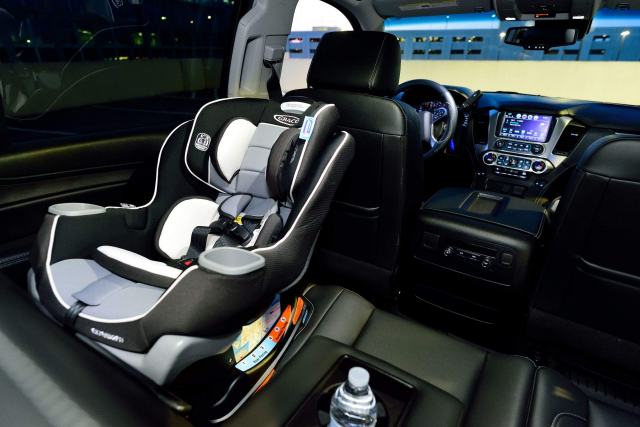
A child car seat in France is a legal requirement for every passenger under the age of ten, whoever owns the vehicle and however short the drive. The rule sits in the road traffic code, it applies to a rental car collected at a Paris airport exactly as it applies to a French family car, and it is checked at roadside stops. Knowing which standard, which seat and which exemption applies saves an argument at the rental desk.
Before you collect the keys
- Every child under ten travels in an approved child restraint matched to their height or weight, in the back of the car.
- Seats sold new in the European Union meet the ECE R129 standard; an older ECE R44 seat already in use stays legal.
- Taxis are exempt from the child car seat rule. A rental car, a private hire car and a friend's vehicle are not.
- Book the seat with the car: airport desks hold limited stock and staff rarely fit it for you.
What French law asks of every driver
Article R412-2 of the French road traffic code says that a child under ten years of age must travel in an approved child restraint system adapted to their size and weight. The wording matters more than it looks. The restraint has to be approved, which rules out a cushion or a folded coat under the adult seatbelt, and it has to fit the child in front of you rather than the one the seat was bought for two years ago.
The obligation follows the vehicle, not the licence. A visitor driving on an American license, a British licence or a French one carries the same duty, and the rental contract does not transfer it to the rental company. The driver is the person a police officer will speak to. Rear seat belts are compulsory for every passenger in France, adults included, and a child old enough to leave the booster still needs the belt routed across the shoulder and the hips rather than under the arm.
One more point catches families out on their first day: the rule covers every journey, including the fifteen minutes from the airport to the hotel and the crawl through Paris traffic on the boulevards. There is no short trip exemption in French law, and there is no exemption for a car borrowed for an afternoon.
ECE R44 and R129, the two approved standards
Two approval standards circulate in France, and both are legal. ECE R44/04 matches the seat to the weight of the child and splits the range into groups, from the infant carrier of group 0+ to the high back booster of group 2 and 3. ECE R129, sold under the name i-Size, matches the seat to the height of the child instead, which is easier to judge and harder to get wrong.
R129 also carries a rule that R44 never had: a baby stays rear facing until at least fifteen months. Child safety research is consistent on this point, and many manufacturers now build seats that keep a toddler rear facing well past two years. New seats offered for sale in the European Union follow R129; an R44 seat bought earlier and still in good condition remains legal to use, which is why a French rental fleet can hold a mix of both.
Whichever seat you are handed, the proof of approval is the orange label glued to the shell. It carries the letter E, a number identifying the country that granted approval, and the standard the seat meets. No orange label, no approval, and the seat is not legal on a French road.
| Standard | How the seat is matched | Rear facing | Worth checking |
|---|---|---|---|
| ECE R129, i-Size | Height of the child, printed on the label | Compulsory to at least 15 months | Needs ISOFIX anchor points in the car |
| ECE R44/04, groups 0+ to 3 | Weight of the child, in kilograms | Compulsory to 9 kg, advised for longer | Belt routing differs between groups |
| Backless booster, group 3 | Taller children only under recent approvals | Not applicable | A high back model protects the head and torso |
Front seat, back seat and the airbag
The default position for a child under ten is the rear bench, and the exceptions are narrow. A child may sit in front when the vehicle has no rear seats at all, when the rear seats are already occupied by other children under ten, or when the rear seats are unusable or missing. A two seater convertible booked for a weekend on the coast therefore falls inside the law, while a saloon with an empty back seat does not.
When a rear facing seat has to go in front, the passenger airbag must be deactivated first. This is the single mistake with the worst consequences, because an airbag firing into the back of an infant carrier is far more dangerous than no airbag at all. In most French rental cars the switch is a key operated barrel in the end of the dashboard or inside the glovebox, and a warning light on the console confirms the airbag is off. Ask the desk to show you before you drive away, and check the light again each time you restart the car.
Front seat or back, never route an adult seat belt around both a parent and a child, and never buckle two children into one belt. Neither arrangement is approved, and both make injuries worse in a frontal impact.
The rule with taxis, and why a private hire car is different
French law exempts taxis from the child car seat requirement. A licensed taxi may carry a child without a restraint, and from the age of three the child travels in the rear secured by the adult seat belt. The exemption exists because a taxi cannot carry a full set of seats for every fare, not because a taxi is safer, and a driver who does carry seats is doing something the law does not force.
The exemption stops at the taxi rank. A ride hailing car booked through an application is a private hire vehicle, a VTC in French, and the ordinary rule applies to it: the child needs an approved seat, and the company must be told the age of the child when the booking is made. The same goes for a private airport transfer. A transfer service that meets you at Charles de Gaulle will offer an infant carrier or a booster on request, usually at no extra charge, but only if the request reaches them before the car is dispatched.
The official position on all of this is published by the French public service portal, which is the reference a police officer will quote back to you (service-public.gouv.fr, consulted in September 2026).
Renting a child car seat with the car in Paris
Every rental company operating at a Paris airport lists child seats as an option, split by age band: infant carrier, toddler seat, booster. Stock is the weak point. Desks at Orly and at the Charles de Gaulle rental terminals hold a fixed number of each category and they run out during school holidays, so a seat that was not reserved with the car may simply not be there at eight in the morning. Reserve it at the same time as the vehicle, then carry the confirmation with the booking reference.
Seats are charged per day, with a cap that applies on longer hires, and the charge sits outside the headline rate of the car. Confirm it at booking rather than at the counter. Expect to fit the seat yourself: most staff decline to install one, because an incorrectly fitted restraint is a liability they will not take on. Allow ten quiet minutes in the car park with the manual rather than doing it in a loading lane.
Inspect what you are given before you sign. The orange approval label should be legible, the straps complete and unfrayed, the shell free of cracks, and the buckle should click firmly. If the car offers ISOFIX anchors, use them. A family of five is usually better served by a seven seat people carrier with three usable rear positions than by a compact car in which two child seats will not sit side by side.
Bringing your own seat, or hiring baby gear in Paris
Most airlines carry a child car seat free of charge in addition to the baggage allowance, so travelling with the seat your child already knows is often the easier option. Check the policy of your own carrier, bag the seat to protect it in the hold, and photograph it at check in so that damage is easy to prove.
One trap applies to visitors from outside Europe. A seat approved only to the American FMVSS 213 standard carries no ECE label and is therefore not approved for use on a French road, whatever its quality. Passengers arriving from the United States are better off hiring a seat on arrival than carrying one that cannot legally be used.
Paris also has a small market in baby gear hire, the same companies that handle stroller rental for visiting families. They deliver a seat, a cot or a pushchair to a hotel or an apartment and collect it at the end of the stay, which suits a trip built around the Métro with one day of driving to Giverny or Disneyland. Book a fortnight ahead in July and August, when demand is heaviest.
What it costs you to get it wrong
Carrying a child without an approved restraint is a traffic offence in the fourth class, dealt with by a fixed fine. A driver holding a French licence also loses points; a visiting driver pays the fine, in practice immediately at the roadside. Officers do check, especially on motorway toll plazas at the start of the holiday season, and the offence is visible from outside the car.
The safety argument is the stronger one. A correctly fitted seat spreads the force of an impact across the frame of the seat instead of the abdomen of a child, and the difference in outcome at ordinary speed limits is large. There is also an insurance dimension worth understanding before you sign anything: read the terms of the cover sold with your rental car, since an insurer may reduce a settlement where a passenger was not restrained as the law requires. Breakdown cover and damage cover say nothing about how a child was seated, and that silence is not in your favour.
Questions travellers ask
What is the age limit for child car seats in France?
Ten years. From the tenth birthday a child may use the adult seat belt, provided it sits correctly on the shoulder and the hips. Many children reach that point comfortably only at around 135 centimetres, so keeping a booster in use past the legal limit is a reasonable choice rather than an excess of caution.
Do I need a car seat for my child in a taxi?
No. Licensed taxis are exempt in France, and a child of three or more travels belted in the rear using the adult seatbelt. A private hire car, a rental car and a friend's vehicle are not covered by that exemption.
Can I use my American car seat in France?
Not legally. A seat must carry an ECE approval label, and seats built to the American standard do not. Hire an approved seat on arrival instead.
How do I rent a car seat in France?
Add it to the car booking online, choosing the category by the age and size of the child, and keep the confirmation. Seats booked at the counter depend on whatever stock is left, which is a poor bet in the school holidays.