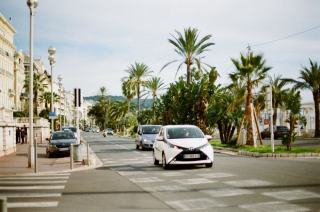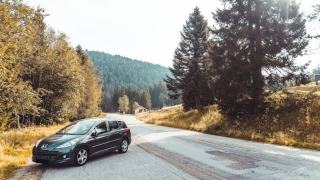

Snow tyres are not compulsory everywhere in France, but a law known as the Loi Montagne makes winter equipment mandatory in designated mountain areas from 1 November to 31 March. Every car is covered, hire cars included, and it is the driver who answers for it.
At a glance
- The obligation runs every winter season from 1 November to 31 March, in communes designated by prefectural decree inside six mountain massifs.
- You satisfy it either with four winter tyres carrying the alpine symbol, or by carrying chains or snow socks for at least two drive wheels.
- Since 1 November 2024 the M+S marking alone is no longer enough: the three peak mountain snowflake symbol is required.
- A rental company has no legal duty to equip the car, so winter equipment has to be requested when you book.
What the Loi Montagne Actually Requires
The Loi Montagne is the short name given to the winter equipment obligation created by a French decree that took effect for the 2021 season. It does not say that every car in France needs snow tyres. It says that inside a defined perimeter, during a defined period, a vehicle must either be fitted with winter tyres or carry a chain or another removable anti-skid device. The two options are alternatives, not cumulative, and you choose the one that suits your trip.
The purpose is traffic flow as much as safety. A single unequipped car stuck sideways on a mountain road blocks everyone behind it, including the gritters and the emergency services. That is why the obligation is compulsory on days when there is no snow on the ground at all: the point is that the car is ready when conditions change, which in the Alps can happen inside an hour.
The decree sets the framework and the prefect of each department sets the map. There is no national list of roads you can memorise before leaving Paris, which is the single most common misunderstanding among visiting drivers. It also means the answer to the question of whether winter equipment is compulsory on a given trip is local, never national.
When and Where the Rule Applies
The Dates
The obligation runs from 1 November to 31 March inclusive, every winter. It is a calendar rule, not a weather rule. On 2 November, with dry roads and fifteen degrees in the valley, an unequipped car inside the zone is still in breach. On 15 April, with fresh snow falling, it is not. Drivers who plan an early season or late season trip are the ones most often caught out, because they associate the requirement with visible snow rather than with the date.
The Six Massifs
The perimeter is drawn inside six mountainous territories: the Alps, the Pyrenees, the Massif central, the Jura, the Vosges and Corsica. Within them, each prefect designates the municipalities concerned, so the zone stops at commune boundaries rather than at contour lines. Departments such as Haute-Savoie, Savoie, Isere, Hautes-Alpes, Haute-Loire, Haute-Garonne and Haute-Corse are heavily affected, but a department appearing on a list does not mean all of it is covered. Each region publishes its own map, and the official prefectural decree is the document that settles a disputed case.
Reading the Signs
Because the map changes, the road itself is your reference. A square blue sign marked with a tyre and a chain shows the entry into a zone where the obligation applies, and a matching sign with a diagonal bar shows the exit. If you have passed the first and not the second, you are inside. Photographing the sign costs nothing and settles any later discussion. Municipalities also publish their perimeter online, and it is worth a look if you are travelling to a single resort, but on the day the panel at the roadside is what a gendarme will consult. That local signage, not a national map, is what marked zones are built on.
Which Vehicles Are Covered
The obligation reaches every vehicle with four wheels or more, which in practice means almost everything a visitor is likely to drive:
- light vehicles, from a city car to a large estate or an SUV hired for the mountains;
- vans and light commercial vehicles;
- motorhomes, which are numerous on Alpine roads even in winter;
- buses and coaches, including the resort transfer coaches and the ski buses;
- heavy goods vehicles, with their own provisions depending on whether they pull a trailer.
Two wheeled vehicles are outside the scope. A car towing a trailer or a caravan is not exempt, and the towing combination is judged on the towing vehicle. The rule follows the vehicle, never the plate: a Belgian, British or Swiss registration inside the zone is treated exactly like a French one, and so is a car you picked up two hours earlier at an airport counter. Road users travelling from other European countries are the group most often surprised by this, because several neighbouring countries tie their own winter rules to the weather rather than to the calendar.
Winter Tyres, Chains or Snow Socks
Three families of equipment satisfy the law, and they do not suit the same trip. Winter tyres are fitted once for the whole season and forgotten. A chain, or a set of snow socks, lives in the boot and is fitted at the roadside, usually in the dark, in the cold, with a queue of cars behind you. For a single trip of a few days, the chain is the cheaper answer; for a season of weekends, the tyres are.
| Equipment | What the law asks | Best suited to |
|---|---|---|
| Winter tyres | Four tyres carrying the alpine symbol | A whole season, or a long stay in the mountains |
| Metal chains | One set carried on board, for two drive wheels | Deep snow and steep resort access roads |
| Snow socks | One set carried on board, for two drive wheels | Occasional use, tight wheel arches, hire cars |
What Counts as a Winter Tyre
A tyre qualifies when it carries the three peak mountain snowflake symbol on the sidewall, a small pictogram of a mountain with a snowflake inside it. All four wheels must be equipped; two winter tyres on the driven axle do not satisfy the obligation and are dangerous in their own right, because the grip balance between the axles becomes unpredictable. Studded tyres are a separate category, permitted from the Saturday before 11 November to the last Sunday in March, with the vehicle held to 90 km/h whatever the posted speed limits in France allow, and a disc displayed at the rear.
Chains and Snow Socks
A chain is fitted to the drive wheels only, and a set covering two wheels is enough for the law. Practise once in a car park before you need it: the first chain fitting on a snow covered verge takes far longer than you expect, and a chain that is tensioned badly will come loose within a kilometre. Textile snow socks go on faster and are kinder to bodywork, but they wear quickly on bare tarmac and are unsuited to a long climb. Whatever you carry, it must fit the tyre size on the car, which is a real trap when the vehicle is not your own.
Two habits save a lot of trouble. Take the chain out of its box before the trip and check that it is complete, because a missing tensioner turns the whole set into dead weight. And fit it before the climb rather than halfway up it, on a flat verge with the hazard lights on, since there is rarely anywhere safe to stop once the gradient starts.
Tread Depth and the Alpine Symbol
The legal minimum tread depth in France is 1.6 mm, and it applies to every tyre on every car all year round. There is no separate legal figure for winter tyres, which surprises many visiting drivers who have read that 3 mm or 4 mm is required. Those numbers are real but they are not French law: 3 mm is the depth below which the winter compound loses most of its advantage, and 4 mm is the legal threshold in Austria, not here.
The practical consequence is that a tyre can be perfectly legal and still be a poor choice for a mountain road in February. The symbol tells you the tyre was designed for winter use; the depth of the grooves tells you how much of that design is left. Both are readable in thirty seconds with the car parked, and both are worth checking before you commit to a mountain pass.
Why a Winter Tyre Works, and When It Stops Being Useful
The difference between a summer tyre and a winter one is chemistry before it is tread pattern. A summer compound is designed to stay stable when it is hot, and it hardens as the temperature drops. Below roughly seven degrees it has already lost a noticeable part of its grip, on wet tarmac as much as on snow. A winter compound stays supple in the same conditions, which is why the gain shows up on a cold, damp December morning in the valley and not only on a white road.
That threshold explains two things that puzzle visiting drivers. It explains why a winter tyre can improve braking on a road with no snow on it at all, and it explains why the same tyre is a poor idea in July, when the soft compound overheats, wears fast and gives away performance. Fitting winter tyres in April and leaving them on until October costs money and grip at the same time.
It also puts the marking in perspective. A tyre marked with the alpine symbol has passed a snow traction test; it says nothing about how the tyre behaves in the cold and dry, which is where most winter kilometres are actually driven. The mountain rule and good winter practice overlap, but they are not the same question.
What Changes When the Car Is a Rental
This is where visiting drivers are most exposed, because the rules are written for owners. A rental company in France has no legal obligation to hand over a car equipped for the mountains. Winter tyres are an option, priced per rental, and they have to be requested when you book the trip rather than asked for at the counter. Paris branches in particular keep very few winter equipped cars, since the overwhelming majority of their fleet never leaves the lowlands. Availability is far better at desks located near the massifs, which is worth knowing if your holiday allows a change of pick-up point.
The liability sits with whoever is driving. A fine issued at a roadside check in the Tarentaise is the driver's, not the rental company's, and no clause in the contract moves it. That is worth knowing before assuming that a car collected at an airport is compliant by default.
A chain raises a second question. Many rental agreements exclude damage caused by fitting a chain, and a chain that breaks at speed can mark an arch or a brake line badly enough to matter. It is worth reading what your rental insurance actually covers before you buy a set at a motorway service area. Snow socks avoid most of that risk, and they are the equipment usually recommended on a hire car for that reason.
Three checks at the desk are enough. Look at the sidewall for the alpine symbol on all four wheels. Ask whether a chain or a set of socks is in the boot, and whether it matches the tyre size fitted. Photograph both, with the mileage, before you drive away.
Penalties If You Are Not Equipped
Driving inside the zone without the required equipment is a fourth class offence under French law, carrying a fixed fine of 135 euros. The gendarmerie may also immobilise the vehicle on the spot, which on a Saturday in heavy holiday traffic is the more painful of the two outcomes. Figures quoted in English language guides vary widely, and some circulate amounts that do not correspond to the French scale of fines at all.
Enforcement in the first seasons leaned towards information rather than penalties, and checks concentrate on the approach roads to the large resorts on changeover Saturdays. That is a reason to be equipped on exactly those days, not a reason to gamble.
Common Questions
Do I need winter tyres to drive from Paris to the Alps?
Not for the motorway section, which lies outside any zone. You need to be equipped from the moment you pass the entry sign, which on most Alpine valleys happens well before the resort itself. Carrying chains covers the whole journey without changing the tyres on the car.
Are all season tyres accepted?
Yes, provided they carry the alpine symbol on the sidewall. Many all season tyres do. The marking is what the law reads, not the commercial name of the range.
Does the obligation apply if there is no snow?
Yes. Between 1 November and 31 March the requirement depends on the date and the location, never on the weather that day.
Can I hire chains for a few days?
Yes, and it is common near resorts, in service stations and at some airport desks. Check that the set matches the tyre size on the car, because a set that does not fit is the same as no set at all.
What about a car registered outside France?
The same rules apply. The obligation follows the vehicle inside the zone, whatever its country of registration.
Do the neighbouring countries have the same rule?
No, and that is the trap when a route crosses a border. Several European countries tie their winter obligation to the state of the road rather than to a fixed date, and some close their high passes altogether in winter. If your trip leaves France, check the rule of each country on the route before travelling, and check whether your rental agreement even allows the crossing.
Driving on Snow Once You Are Equipped
Equipment buys grip; it does not remove the need to drive differently. On a snow covered surface, braking distances lengthen far more than most drivers expect, and the safe gap on a mountain descent is several times the one you would leave on a dry motorway. Speed limits already drop in rain, and on snow the sensible speed is well below the sign whatever the panel says.
Two habits matter more than any others. Brake and steer separately rather than together, since a tyre asked to do both at once on ice does neither well. And use engine braking on long descents instead of riding the brakes, which on an automatic hire car means selecting a lower range rather than leaving the box to decide.
Fuel deserves a thought of its own in winter. Cold engines, heated screens and long idling queues push consumption well above the summer figure for the same trip, and mountain fuel stations are further apart and close earlier than the ones on the motorway network. Filling up in the valley rather than in the resort is the habit to keep, and our page on fuel stations in France covers the payment side, which catches out foreign cards more often than the price does.
Finally, plan the day around the traffic rather than the distance. Resort access roads carry their entire weekly turnover on the changeover Saturday of the school holidays, and an incident at the wrong point of a narrow valley road can hold everything for hours. Leaving early, with a full tank and the equipment already in the boot, is worth more than any driving technique. That is the plainest advice in this guide and the one most often ignored.