
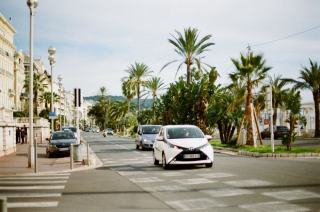
A one-way car rental lets you collect a vehicle in Paris and return it at a different branch, in another French city or at another airport, instead of bringing it back where you started. Rental companies charge a drop-off fee for this, because the car has to be repositioned. The fee depends on distance, direction and season far more than on the length of the hire.
The essentials
- A one-way hire is priced on the route, not on the number of days.
- The drop-off fee covers repositioning the car, so it rises with distance and with demand imbalance.
- Domestic one-way journeys within France are straightforward; crossing a border is restricted and costs considerably more.
- Station and city branches close earlier than airport desks, which matters if you arrive late.
What a One-Way Rental Actually Is
One-way car rental in France means the pick-up branch and the return branch are not the same. You might collect at Charles de Gaulle and drop off in Nice, or start at our Gare de Lyon downtown office and finish in Bordeaux. Everything else works as usual: the same booking, the same contract, the same insurance cover. The only structural difference is that the vehicle ends its hire somewhere it did not begin, and someone has to deal with that.
This is why it suits a particular kind of trip. If you are flying into Paris and out of Marseille, a return hire would force you to drive the whole way back to collect your flight. A one-way booking removes that leg entirely. The same logic applies to a road trip down to the south of France where the point is to keep moving rather than to loop back to the starting point.
One-way hires are available from all our Paris locations, including the Charles de Gaulle airport desks, Orly, and our city branches. Availability is not automatic on every vehicle category: specialised models and larger vans are more often restricted to return-to-base bookings, simply because there are fewer of them and moving them back is harder.
Why a Drop-Off Fee Exists
The drop-off fee, sometimes called the one-way fee, is not an administrative surcharge invented to pad the bill. A rental fleet is balanced across branches according to expected demand. When you leave a car in Nice that was supposed to be working in Paris, that balance breaks. Either the company transports the vehicle back, which costs a driver and a tank of fuel, or it accepts a surplus in one place and a shortage in another. Short transfers are the exception that proves the rule: moving a car between our Paris branches, or between the two Paris airports, is cheap to rebalance and carries no surcharge. The fee only becomes significant once the two branches are several hundred kilometres apart.
That mechanism explains something travellers often find counter-intuitive: the fee is not symmetrical. The same route can cost more in one direction than the other, and the gap can be substantial. In July and August the flow of holiday traffic runs from Paris towards the coast and the south, so cars accumulate there. A company that already has too many vehicles in Nice has little reason to reward you for bringing another one. Driving the opposite way, returning a car to Paris in late August, moves a vehicle back to where it is needed, and the fee reflects that.
The practical consequence is worth acting on. If your dates are flexible, or if either end of the journey could be reversed, it is worth pricing both directions before you book rather than assuming the cost is fixed by the distance alone.
What Moves the Price
- Distance between branches. The dominant factor. Paris to Lyon is roughly 465 km by road, Paris to Bordeaux about 585 km, Paris to Marseille around 775 km, and Paris to Nice close to 930 km.
- Direction and season. The imbalance described above. Outbound in high summer is the expensive direction on southern routes.
- Vehicle category. Economy and compact cars are the most widely available for one-way bookings. Premium models, convertibles and nine-seat minivans are more often restricted.
- Type of branch. Airport and major station desks form a dense network and are the easiest to combine. A small suburban branch may not accept an inbound one-way at all.
- How far ahead you book. One-way availability is capped per branch and per category, and it is the first thing to disappear on popular summer routes.
Note what is not on that list: the number of days. A one-way fee is charged on the route, so a three-day hire from Paris to Nice and a ten-day hire on the same pair of branches carry the same repositioning cost. If you were planning a short trip, the fee weighs proportionally much more on the total, which is exactly when the alternatives below deserve a look.
Crossing a Border
Returning a French car in another country is a different proposition and should never be assumed. International one-way hire is restricted by vehicle category, is not offered on every route, and carries a fee on a different scale from a domestic drop-off, because repatriating the vehicle means an international journey rather than a national one.
It also has to be declared when you book. Cross-border travel affects the terms of your rental insurance cover, and an undeclared international drop-off can leave you outside the terms of the contract at the worst possible moment. If your itinerary ends in Geneva, Barcelona or Brussels, say so at the booking stage and have it written into the agreement.
Practical Checks Before You Set Off
Confirm the exact return address, not just the city. Large cities have several branches, and a drop-off booked at the airport cannot simply be swapped for the station on the day. Check the opening hours of that specific branch too: airport desks generally run long hours, while station and city offices close earlier and many are shut on Sunday. Out-of-hours key drop is not available everywhere, and where it is, the vehicle usually remains your responsibility until staff inspect it the following working day.
Plan the fuel. The most common surprise on a long one-way trip is not the drop-off fee but the refuelling policy: returning a car below the agreed level is charged at a rate well above the pump price. Locate a station a few kilometres before the return branch rather than trusting that one will appear. On a southbound run you should also budget for motorway tolls, which on the long autoroutes towards Lyon and the Mediterranean add a real sum to the journey.
Finally, think about the car itself. A long one-way drive is mostly motorway, and that is a different exercise from city driving. If you are not used to a manual gearbox, an automatic transmission is far less tiring over several hundred kilometres, and it is easier to reserve in advance than to arrange on the day.
Mileage, Deposit and the Paperwork
On a long one-way drive the mileage terms matter as much as the drop-off fee, and they are easy to overlook. A rate advertised with a daily mileage allowance can work out badly on a route like Paris to Nice, where a single leg swallows the best part of a thousand kilometres before you have driven anywhere locally. Unlimited mileage removes that risk entirely, and on a long transfer it is usually the term worth paying for. Read the mileage limits on the rate you choose rather than assuming they are generous.
The deposit works the same way as on any hire: a pre-authorisation is held on a credit card in the main driver's name, and the amount varies with the vehicle category rather than with the route. A debit card is not always accepted, and this is the single most common reason a booking falls apart at the counter. Check which cards the pick-up branch takes before you travel, along with the licence and documents required to hire a car in France, since the conditions are identical whether you bring the car back or leave it at the other end of the country.
When the Train Beats a One-Way Hire
France has an unusually dense high-speed rail network radiating from Paris, and on some journeys it makes a one-way rental the wrong tool. If your plan is simply to get from Paris to a distant city and then explore locally, taking the train and hiring a car on arrival avoids the drop-off fee, the tolls and several hours of motorway driving. Most major stations have rental desks.
The calculation changes when the drive itself is the point. If you intend to stop in the Loire, spend a night in Burgundy or follow the coast, the car is doing something the train cannot, and the one-way fee buys you that freedom. The question to ask is not which is cheaper in the abstract, but whether you actually want the road between the two cities. Whichever you choose, book the car before you arrive rather than at the counter.
Common Questions
Can I return a car to a different city in France?
Yes. Domestic one-way rentals between French branches are standard, subject to availability in the vehicle category you want. The return branch must be selected when you book, because the drop-off fee is calculated from the specific pair of locations.
Is the drop-off fee charged per day?
No. It is a one-off charge tied to the route, not to the duration of the hire. A short rental and a long one between the same two branches carry the same fee.
Why is the fee different in the opposite direction?
Because it reflects where the fleet needs vehicles. Moving a car towards a branch that is short of stock costs the company less than adding one to a branch that already has a surplus, and the price follows that imbalance.
Can I drop the car off outside opening hours?
Only where the branch offers a key drop, and it is not available everywhere. Where it exists, the vehicle normally stays under your responsibility until staff can inspect it on the next working day, so confirm the arrangement before you rely on it.
Can I return a French rental car in another country?
Sometimes, but it must be agreed in advance. International one-way returns are limited to certain routes and vehicle categories, cost considerably more than a domestic drop-off, and have to be declared at booking so the insurance terms cover the journey.