
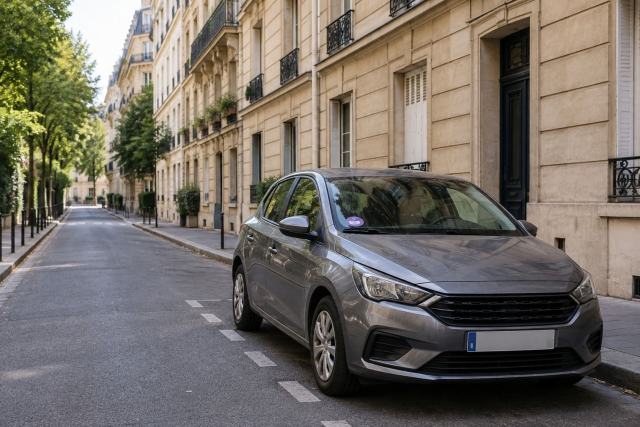
Yes: every vehicle driving in Paris on weekdays needs a Crit'Air sticker, and a rental vehicle registered in France almost always leaves the counter with the air sticker already on the windscreen. The Crit'Air air quality certificate classes each vehicle by its emissions, and the Paris emission zone uses the sticker to decide which vehicle may drive. Check the Crit'Air class, the zone and the air pollution days before you travel.
What is the Crit'Air sticker?
The Crit'Air sticker is a round, coloured air quality certificate issued by the French government. In French it is called the vignette Crit'Air or certificat qualité de l'air. It shows a number from 0 to 5 that reflects the vehicle's level of pollutant emissions (niveau d'émissions polluantes), worked out from two facts: the fuel type and the Euro emission standard (norme Euro) recorded when the vehicle was registered, or first put on the road (mis en circulation).
The sticker exists because French cities with poor air quality have created low emission zones, called ZFE (zone à faibles émissions). Inside such a zone, a car without a Crit'Air sticker, or with a class that is too high, is not allowed to drive during the restricted hours. The air sticker is the only proof an officer or a camera needs: no paperwork, no online check at the roadside.
Crit'Air is a national scheme. The same sticker works in Paris, Lyon, Grenoble, Strasbourg and every other French city with a low emission zone, so a rental driver doing a longer trip across France does not need several certificates. Only the rules on which classes may enter differ from city to city.
The six Crit'Air classes and the vehicles in each
Each class has its own colour, which makes the sticker easy to read through a windscreen. The lower the number, the cleaner the vehicle. The table below matches the classes to the car types you are likely to be offered at a rental desk in Paris.
| Crit'Air class | Colour | Typical cars | Paris weekday access |
|---|---|---|---|
| Crit'Air 0 | Green | Fully electric and hydrogen vehicles | Allowed, even on most pollution days |
| Crit'Air 1 | Purple | Petrol Euro 5 and Euro 6, gas and plug-in hybrids | Allowed |
| Crit'Air 2 | Yellow | Diesel Euro 5 and Euro 6, petrol Euro 4 | Allowed, may be restricted on pollution days |
| Crit'Air 3 | Orange | Diesel Euro 4, petrol Euro 2 and Euro 3 | Not allowed inside the zone |
| Crit'Air 4 | Burgundy | Diesel Euro 3 | Not allowed |
| Crit'Air 5 | Grey | Diesel Euro 2 | Not allowed |
Older vehicles, such as a diesel car made before 2001, are "unclassified" and cannot get a sticker at all. A modern rental fleet, whatever the vehicle size, is almost entirely Crit'Air 1 or 2, and a growing share is Crit'Air 0 if you choose an electric car for your trip around France. In practice, the class you drive away with is rarely the issue; the missing sticker is.
Is the Crit'Air sticker mandatory in Paris?
Yes. The whole of Paris, and the part of the Greater Paris area (Métropole du Grand Paris) inside the A86 ring road, forms one emission zone. The restrictions apply Monday to Friday, from 8 am to 8 pm, public holidays excepted. Within those hours, a car without a sticker is treated as if it were in the worst category and is not allowed to circulate in the zone (circuler dans la zone).
Since 1 January 2025, Crit'Air 3 vehicles are no longer permitted to drive in the zone on weekdays, on top of classes 4 and 5 and unclassified vehicles banned earlier. The Paris ringroad (boulevard périphérique) is part of the zone; the A86 itself is not, which lets through traffic go around. Evenings and weekends are open to all classes, except during a pollution episode.
The ZFE has been debated in Parliament, and a law voted in 2025 planned to scrap low emission zones. The Constitutional Council struck that provision down on 21 May 2026, so the Paris ZFE stays in force. For a visitor, the practical rule is simple: if you drive into the city on a weekday, the sticker is obligatory, whatever your nationality or the country where the car is registered.
Does a rental car come with the sticker?
A car hired in France is registered in France, and the main rental companies order the Crit'Air certificate for each vehicle when it enters their fleet. It is stuck on the inside of the windscreen, usually at the bottom right or next to the rear-view mirror. At the counter, or in the parking bay, take ten seconds to look for it before you drive off.
Three situations deserve a closer look:
- A brand new vehicle: a car put into service a few days ago may not have its sticker yet. Ask the agent; the registration number is enough to check the class online.
- A replacement car: after a breakdown, the car brought to you may come from another branch or partner and has not always been checked.
- A peer-to-peer rental or a car from a small local firm: the owner is responsible for the sticker, and some forget.
If the sticker is missing, ask for another car rather than hoping for the best. The fine goes to the driver in most cases, as explained on our page about what happens to a traffic fine with a rental car, and the rental firm usually adds a handling fee when it forwards it. Picking up a car at a Paris airport counter is a good moment to check: you drive straight into the zone as soon as you pass the A86.
How to order a Crit'Air sticker for a car registered abroad
If you drive into Paris with your own car, or with a car rented in another country (a UK, Swiss, Belgian or German hire car), the rule is the same: a vehicle registered outside France needs a Crit'Air sticker too. The French motor authorities offer an English version of the application, and the only official website is certificat-air.gouv.fr. You pay online by credit card and receive the air quality certificate by post.
The steps to demander en ligne are short:
- Choose the "vehicle registered abroad" option on the official site.
- Upload a scan of the registration certificate (the V5C log book in the UK, the Fahrzeugschein in Germany, and so on).
- Enter the date of first registration, the fuel and the Euro standard, then pay.
- Wait for the sticker to arrive by post, and stick it inside the windscreen.
Delivery abroad can take several weeks, so order well before the trip. The site asks for a recent browser: a current version of Firefox, Chrome, Safari or Microsoft Edge works. Beware of look-alike websites that charge several times the official fee for the same sticker: only the government site issues it. A few foreign cars registered before the Euro standards were recorded may be classed by date of registration instead of Euro norm.
Frequently asked questions about the sticker in Paris
What are the fines for not having a Crit'Air sticker?
Driving in the Paris zone during restricted hours without a sticker, or with a banned class, is a third-class offence under the French Highway Code (code de la route). For a car, the standard fine is €68, reduced if paid quickly and increased if paid late. Heavy vehicles, coaches and buses face a higher, fourth-class fine. Controls are carried out by the police; automated camera checks have been announced for several years.
Do tourists and foreign drivers need a Crit'Air sticker?
Yes. There is no exemption for a vehicle registered abroad or for a short visit. The obligation covers cars, vans, motorbikes, coaches and lorries. A foreign driver in a rental car from a French agency is covered by the sticker already on the vehicle.
Is there a day pass for a car without the right sticker?
The Greater Paris area offers a "Pass ZFE 24h" allowing a non-compliant vehicle to drive in the zone a limited number of days per year. It is intended for occasional drivers with an older car; a rental customer has no reason to use it, since the car should already meet the rules.
Do I need the sticker on weekends?
No, as long as there is no pollution alert. The standing restrictions in Paris apply only on weekdays between 8 am and 8 pm. Keeping the sticker on the car all the time costs nothing and avoids surprises on a Monday morning.
How does the Crit'Air sticker affect driving in Paris on pollution days?
During an air pollution episode, the Paris police prefecture can impose "differentiated traffic" (circulation différenciée). Only the cleaner Crit'Air classes may then drive, and the restrictions often extend beyond the usual zone and into weekends. Depending on the severity, Crit'Air 2 vehicles, and sometimes Crit'Air 1, can be banned for the day. Speed limits are usually reduced at the same time.
These decisions are announced the day before, on the prefecture's website, in the news and on traffic information services (info trafic). Public transport (transports en commun) sometimes gets cheaper fares on those days to encourage people to leave the car. For a visitor with a diesel Euro 6 rental, a Crit'Air 2 class, this is the one situation where the sticker can stop you from using the car in the city. An electric or petrol hybrid model avoids the question entirely.
If your trip falls during a heatwave or a cold, still winter week, both typical pollution periods, check the forecast the evening before. Our tips for driving in the French capital cover the other daily traps: priority to the right, bus lanes and the Arc de Triomphe roundabout.
French words you will meet on signs and official pages
Most official pages and road signs about the scheme are in French, and a few phrases come up again and again. Knowing them helps any foreign driver travel through French cities with confidence:
- Vignette Crit'Air obligatoire
- The sticker is compulsory: this is written on the sign at the entrance of the emission zone, often with the list of classes allowed.
- Zone à faibles émissions (ZFE)
- Low emission zone. The sign shows the cities or the ring road concerned and the hours when the restrictions apply.
- Pour circuler dans la ville
- "To drive in the city": the phrase that introduces the conditions every véhicule must meet.
- Restrictions de circulation
- Traffic restrictions, the heading used by the prefecture and in news articles (actualités) on pollution days.
- Qualité de l'air
- Air quality, as in certificat qualité de l'air, the official name of the sticker.
- Voiture électrique
- Electric car, the only type of vehicle that gets the green Crit'Air 0 sticker.
- Contrôle
- A police check; officers compare the sticker on the vehicle with the class allowed.
The ministère de la Transition écologique publishes the rules on its site (a gouv.fr address), and the service public website sums up the obligations for drivers. Both pages confirm the dates quoted in this article, such as the Crit'Air 3 ban in force depuis le 1er janvier 2025. Rules can also apply in other cities you may travel through: Lyon, Grenoble and Montpellier each set their own classes and hours, so check before you drive a vehicle into another zone.
Crit'Air, parking and insurance: what the sticker does not change
The Crit'Air certificate is only about air quality. It has no link with car insurance, road tax or parking rights. A car with a Crit'Air 1 sticker still pays for street parking in Paris, and residential parking permits are a separate system. Car insurance is not voided if you forget the sticker, but the fine remains yours to pay.
The sticker also does not replace motorway tolls, speed cameras or the other obligations of driving in France: a valid licence, the registration document in the car, a warning triangle and a high-visibility vest. It is a small round piece of paper, but it is the one document of the car that everyone outside can see, which is precisely why the emission zone relies on it.
To sum up the steps for a rental driver: look for the sticker when you collect the car, note its class, avoid weekday driving inside the A86 if the class is 3 or above, and check the pollution alerts before any trip into the city. With a car from a French rental agency, the Crit'Air sticker for Paris is almost always already in place.